
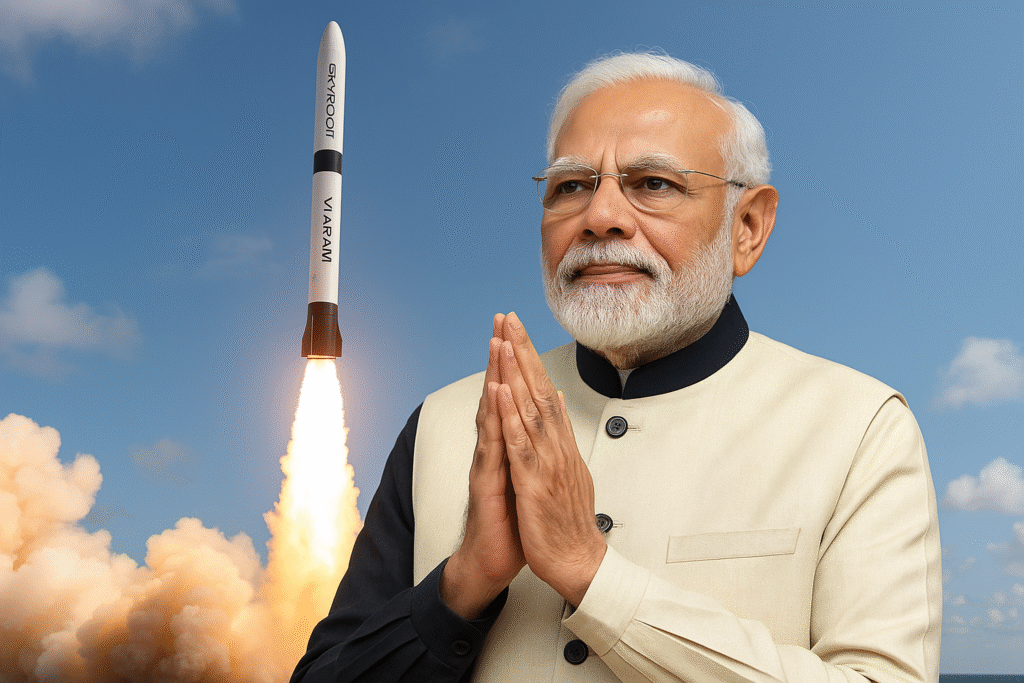
🚀 What is Vikram-I
- Vikram-I is a four-stage orbital-class launch vehicle, designed to carry small satellites into Low Earth Orbit (LEO).
- With a lightweight carbon-fibre structure and 3D-printed hypergolic engines, the rocket emphasises rapid, cost-efficient, and flexible satellite deployment
According to Skyroot, the new facility has capacity to manufacture one orbital rocket every month — a production scale that could meet growing satellite-launch demand.
In their celebratory tweet, Skyroot wrote:
“Lift-off for Infinity 🚀 The Honourable Prime Minister Shri @narendramodi has given wings to our dreams… unveiling our flight-ready Vikram-1 orbital launch vehicle. This moment brings both inspiration and responsibility as we build a future of infinite possibilities.”
Lift-off for Infinity🚀
— Skyroot Aerospace (@SkyrootA) November 28, 2025
The Honourable Prime Minister Shri @narendramodi has given wings to our dreams: Inaugurating our brand new Infinity Campus and unveiling our flight-ready Vikram-1 orbital launch vehicle.
This moment brings both inspiration and responsibility as we build… pic.twitter.com/4dIOLFRi9Y
🇮🇳 Why This Matters for India
- This marks the first privately developed orbital rocket in India, showing how private enterprise is joining the space race alongside the national agency.
- Government reforms opening the space sector to private companies have started to pay off. During the event, PM Modi highlighted that today’s youth and innovators — not just traditional institutions — are driving India’s space ambitions.
- The Infinity Campus and Vikram-I together position India to become a serious player in the global small-satellite launch market — potentially creating jobs, building infrastructure, and attracting global customers.
What’s Next
Skyroot plans the maiden launch of Vikram-I in the coming months, targeting early 2026. If successful, it could open the door for frequent, on-demand satellite launches — not just for India, but for international clients too.
This isn’t just about rockets — it’s about making space more accessible, faster, and affordable. For many young engineers and entrepreneurs across India, this moment can be an inspiring signal: that with vision, skill, and support, even the sky is no longer the limit.
